Whimsy Modules
Fly-Fishing
A Corporate Absurdist Mime
Waterloo International Street Theatre Festival, Canada, 2001
Something old. Something new. Something borrowed. A fish.
The Clown journey of Martin Ewen — last year it was Lurk, this year Sturgeon. With his hallmark eccentricity and customary absurdity, Martin Ewen (NZ) brings the seedy underhand world of corporate competition out into the open. Gasp at the treachery, marvel at the cunning, palpitate at the stupidity of this set piece as flies (mostly local) become a currency of success.
Flyfishing- is a further example of a sardonic undercut style and performed by two of Canada's finest freestyle comedians. It is designed to alter your perception of middle management forever...
20–40 minutes. Setup is improvisationally paced — five to fifteen minutes depending on the day, the crowd, and the flies.
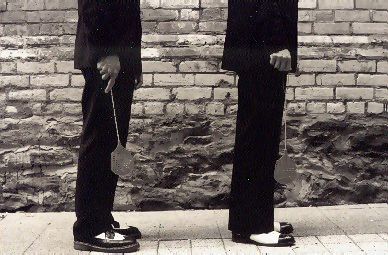
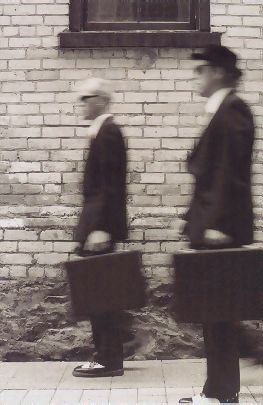
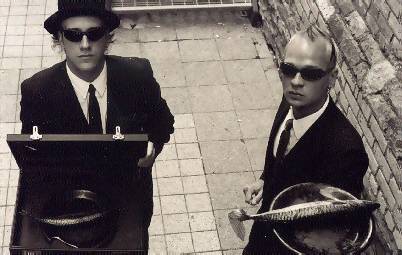
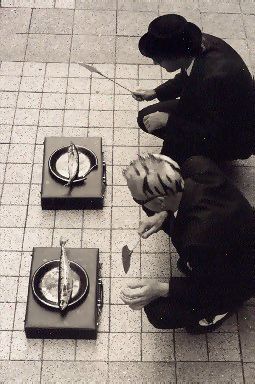
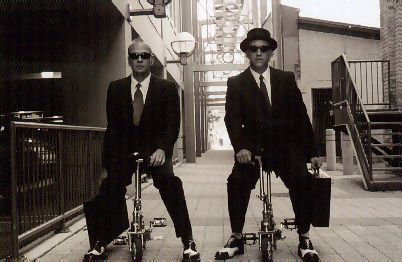
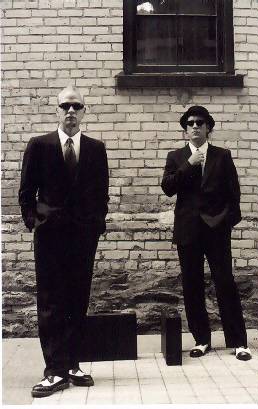
Two absurd businessmen arrive separately, each wheeling a fold-out table and carrying a briefcase. They are, from the outset, competitive. The tables unfold. From the briefcases: a plate, a fish, a flyswat, a jar, tweezers. These are arranged with the gravity of men who know exactly what they are doing and why it matters.
The setup takes as long as it takes. Binoculars appear. A remote control. The improvisational grab-bag deploys as required. The audience watches, uncertain of the premise, which is precisely the point.
It becomes apparent. The fish, on the plates, are bait. The flies are the quarry. Each businessman is catching flies with his swat, transferring them with tweezers to his jar. They are competing. In real time, in daylight, real flies are caught.
Midway through, one businessman produces a thermos and takes a coffee break. His colleague responds in furious mime — the outrage of a professional confronting the unconscionable. Scornful of criticism, the resting businessman selects a volunteer from the audience and deputises them with the flyswat. The audience invariably cheers each successful swat with the fervour reserved for someone who has briefly escaped their own life.
Concluding his break, the businessman retrieves the volunteer, produces a coin, and leads them to an object that has been present but unacknowledged — a covered bulk behind the action. The fabric comes off. It is an analogue coin-operated vending machine, non-electrical, entirely self-sufficient. The coin goes in. The handle turns. A small egg emerges.
Inside the egg: one fake fly, and a slip of paper bearing the fly's name, its favourite pastime, and its favourite smell. The production has compiled painstaking lists. The volunteer is applauded and returned to the audience.
Competition resumes. Watches are consulted with increasing urgency. The pace builds. In the final thirty seconds the theme from the television programme Countdown plays to its abrupt conclusion. Flyswats are laid down. After a beat, everything — plates, fish, jars, tweezers — is returned to the briefcases. Tables fold.
The businessmen bow to whatever scattered bemused applause they can muster and march off promptly. The vending machine remains. The audience approaches it at their own discretion. After a suitable interval it is retrieved by the same roadie who delivered it.